
The Source Is Disappearing
Google AI Mode and the OSINT Problem of the Disappearing Source

Search used to begin with a list of sources.
Now, increasingly, it begins with an answer.
That shift looks convenient on the surface. Google AI Mode and AI Overviews are designed to compress the web into a conversational response: a user asks, the system reads across pages, summarizes what it finds, and offers a few links for context. For everyday browsing, this may feel faster. For OSINT, journalism, and digital investigation, it changes something more fundamental.
It changes the analyst’s first contact with evidence.
The problem is not only that AI-generated answers can be wrong. The deeper issue is that they can make the original source chain harder to see. A claim may arrive already cleaned, compressed, paraphrased, and detached from the messy context that gives it meaning: who published it, when it appeared, what wording was used, what other sources contradicted it, and whether the page has changed since.
For OSINT work, that context is not decoration. It is the work.
An AI answer can be useful as a lead. It can surface entities, suggest possible angles, and help map a topic quickly. But a lead is not a source. A generated paragraph is not an evidence trail. And a link attached to an AI summary is not automatically proof that the claim is supported by that page.
This is where AI-mediated search becomes risky: it can make weak evidence look tidy.
One of the key shifts is interface behavior. Traditional search pushed the investigator outward: open a result, compare pages, inspect timestamps, save URLs, look for primary material. AI Mode can keep the user inside the conversation. Follow-up questions become easier than source checking. The answer improves in fluency, but the research path may become less reproducible.
That matters especially in investigations involving breaking news, cyber incidents, disinformation, corporate ownership, conflict footage, public records, sanctions, online identities, or any topic where timing and provenance affect interpretation.
A generated answer may merge three very different source types into one smooth paragraph: an official statement, a media report, and a social media claim. To a casual reader, the result may look coherent. To an investigator, that coherence can be a warning sign.
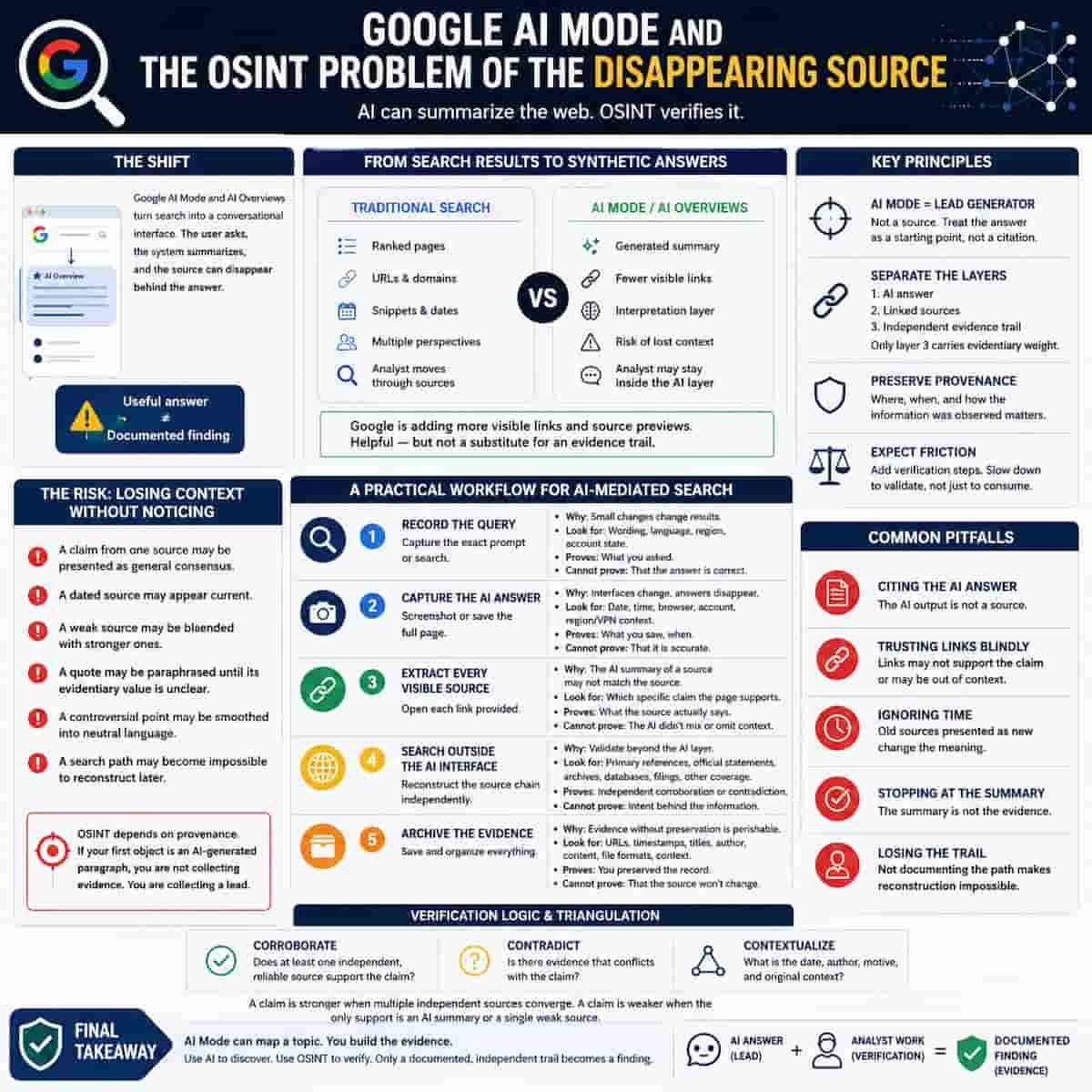
The missing question is: what exactly supports what?
This is the discipline OSINT needs to preserve. AI Mode should not be treated as the end point of research, but as a starting layer that must be reopened. The analyst has to separate the AI answer from the linked sources, then separate the linked sources from independently verified evidence.
That means recording the query, capturing the generated answer, opening every visible source, checking whether each source actually supports the claim, and searching outside the AI interface. It also means preserving dates, URLs, screenshots, archive links, and the conditions under which the result appeared.
The workflow is not complicated, but it is easy to skip because the interface is built to reduce friction.
OSINT often requires putting friction back.
There is also a personalization problem. AI search can vary based on account state, location, language, subscriptions, previous activity, and interface changes. Two analysts may not see the same answer or the same source set. That does not make AI search unusable. It makes documentation more important.
The central rule is simple: never cite the answer when you can cite the evidence.
The full piece breaks down the practical workflow for reopening the source chain behind AI-generated search results, including what to capture, what to verify, and how to avoid treating summaries as findings.
Read the full analysis on Project OSINT:
https://projectosint.com/google-ai-mode-osint-disappearing-source
If this is useful, share it.
This is the weekly selection. But it’s not the only one.
If you’d like to read more: → full articles on the website
If you’d like to get the latest updates first: → Telegram