

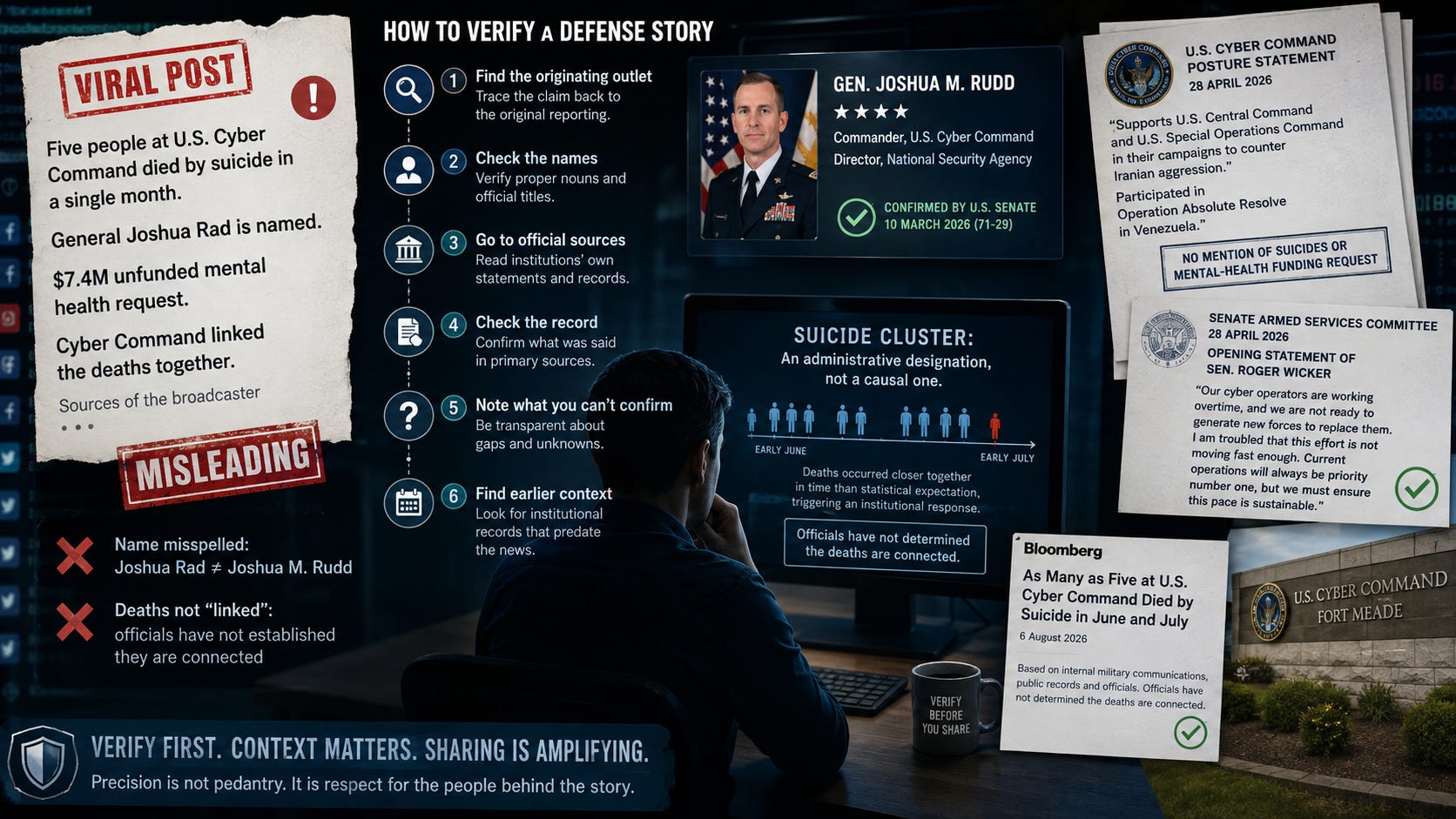
A short post lands in your feed. Five people at U.S. Cyber Command died by suicide in a single month. A four-star general is named. A dollar figure is attached to an unfunded mental-health request. The command, the post says, has linked the deaths together.
It reads like reporting. It has dates, names, numbers. And two of those details are wrong.
The general’s name is misspelled in a way that would send you to an empty search result. And the claim that the command “linked” the deaths misstates the single most important fact in the story: officials have not established that the deaths are connected. That distinction is the difference between a workforce tragedy and a conspiracy.
This is what most disinformation looks like in 2026. Not fabrication, but a real story that loses precision every time it is summarized, translated and reposted. The underlying reporting here is solid. What reaches you is a degraded copy. Learning to verify a defense story against primary sources is not an academic exercise — it is the difference between amplifying journalism and amplifying noise.
What does “suicide cluster” actually mean?
Start with the term itself, because it is doing the heaviest lifting and it is the term most often misread.
A suicide cluster is an administrative and epidemiological designation, not a causal one. It means deaths have occurred closer together in time than statistical expectation, in a defined population, at a rate that triggers a specific institutional response. Declaring a cluster does not assert that the deaths share a cause, that the people knew each other, or that anything links them beyond timing. It is a threshold for intervention.
Bloomberg reported on 6 August 2026 that as many as five people who worked for or closely with U.S. Cyber Command died by suicide between early June and early July, based on internal military communications, public records and officials. The command applied the cluster designation because of the compressed timeframe. Coverage consistently notes that officials have not determined the deaths are connected.
Note the hedge in the original: as many as five. Not “five.” The number in the summary post has hardened into a fact it was never reported as.
How do you trace a claim back to its primary source?
The following process took under an hour and requires nothing but a browser. It works on almost any defense or intelligence story.
1. Identify the originating outlet, not the outlet you read. The post in your feed cites “sources of the broadcaster” or nothing at all. Search a distinctive phrase from it. In this case every downstream version — Japanese, Azerbaijani, Iranian, Russian — traces to one Bloomberg article. Everything else is aggregation. If you cannot find an originating outlet, that is your finding.
2. Correct the proper nouns first. Names are the cheapest thing to check and the most revealing when wrong. The commander of U.S. Cyber Command is General Joshua M. Rudd, confirmed by the Senate on 10 March 2026 by a vote of 71-29, serving simultaneously as Director of the National Security Agency. He is not “Joshua Rad.” A misspelled principal is a reliable signal that the text has passed through several hands, at least one of which was working from audio or a machine translation.
3. Go to the institution’s own publications. Cybercom.mil hosts Rudd’s full posture statement to the Senate Armed Services Committee, dated 28 April 2026. It confirms that the command supports U.S. Central Command and U.S. Special Operations Command “in their campaigns to counter Iranian aggression,” and that it participated in Operation Absolute Resolve in Venezuela. Primary documents also tell you what is absent: the posture statement makes no mention of the suicides or the mental-health funding request, which is consistent with a document written months earlier.
4. Check the congressional record separately from the reporting about it. Senator Roger Wicker’s own site publishes his opening statement from that hearing verbatim. The relevant passage: “Our cyber operators are working overtime, and we are not ready to generate new forces to replace them. I am troubled that this effort is not moving fast enough. Current operations will always be priority number one, but we must ensure this pace is sustainable.” The summary post paraphrased this accurately. That is worth confirming rather than assuming.
5. Separate what you verified from what you could not. The same post attributes a statement about the Iran war to Senator Jack Reed at that hearing. I could not locate a primary source for it. Cyber Command’s involvement in operations against Iran is independently documented — DefenseScoop reported in March 2026 that Rudd took command while Cybercom was supporting Operation Epic Fury — but the specific attribution to Reed remains unconfirmed. Say so, in those words. An honest gap is stronger than a smoothed-over one.
6. Find the institutional record that predates the news. This is the step most people skip, and it is the one that changes the story. U.S. Cyber Command published its own account, through DVIDS, of embedding licensed mental-health providers inside its Fort Meade spaces. The open house was 11 May 2026; clinical care began 12 May. In it, Major CJ McAulay, the command psychologist, drew the comparison to special operations directly: both communities are “always in the fight,” but where SOF personnel rotate between training, deployment and recovery, cyber personnel are “almost never out of the fight.” He named the cost — “the personnel price of persistent engagement is real” — and its shape: disrupted sleep, exercise, nutrition and social interaction.
That statement was published by the command itself, weeks before the deaths, and it is the strongest available evidence for the workload interpretation. It is also the piece the viral summary rendered most vaguely.
Common errors along the way. Treating an aggregator as a source. Trusting a number that arrives without its hedge. Reading “cluster” as “connected.” Accepting a paraphrased quote when the verbatim text is one search away. And the subtler one: stopping once the story is confirmed, instead of continuing until you understand what it means.
Expected result. A version of the story you can defend line by line, with a short, explicit list of what you could not confirm.
Why this matters beyond one story
For newsrooms and independent publishers, the practical takeaway is that the verification cost of a story like this is roughly an hour, and skipping it produces text that is confidently wrong about the only thing that matters.
For anyone tracking defense and intelligence topics, the structural lesson is different. High-demand, low-density military communities — special operations, drone crews, now cyber operators — have produced comparable episodes before. The public record here does not require inference. A committee chairman said the pace was unsustainable in April. The command’s own psychologist described the mechanism in May. The commander placed mental-health sustainment second on his unfunded priorities list, at roughly $11 million, warning of burnout and force degradation without it. The deaths followed.
None of that establishes causation, and no responsible reading claims it does. What it establishes is that the warnings were on the record, in public, in the institution’s own words, before anyone needed them to explain anything.
The practical criterion to carry forward: when a summary tells you an institution has “linked” a set of events, go and read whether it actually said so. That single check catches most of what goes wrong between the original reporting and your feed.
If you or someone you know is struggling, help is available. In the United States, call or text 988, or chat at 988lifeline.org.
Sources: Bloomberg · NSA – Gen. Rudd bio · DefenseScoop · DVIDS – USCYBERCOM/Kimbrough · SASC hearing 28/04/2026 · Breaking Defense
While a "cluster" is indeed used to refer to a statistical anomaly without making any claim about causation, there are unique aspects of a suicide cluster that make an asserted suicide cluster more unsettling.
Suicide is contagious, and the contagion is carried by news of the death. Even hearing about a fictional suicide can trigger follow-along suicides (Werther Effect). On one hand, that means suicides are intentionally underreported out of concern for those who might react to the news with their own suicide. On the other hand, it means suicide clusters often don't have an external cause, just an initial case triggering a chain reaction.
And there's the ethical question: will our reporting about the suicides lead some who otherwise would not, to their own suicide?
One distinction worth adding to this methodology is event date versus public-observability date.
The Cyber Command/DVIDS example makes it unusually clear: the mental-health open house occurred May 11 and clinical care began May 12, but the DVIDS account was posted June 26.
For retrospective analysis, those dates cannot be treated as interchangeable.
What an institution knew or was doing internally is different from what an external analyst could actually have known at the time.
Preserving that boundary helps prevent hindsight from making an earlier signal look more predictive than it really was.